A few weeks ago, I made a trip that I’ve been meaning to make for years – ever since I was a kid reading my old, beat-up Time-Life Gettysburg book.
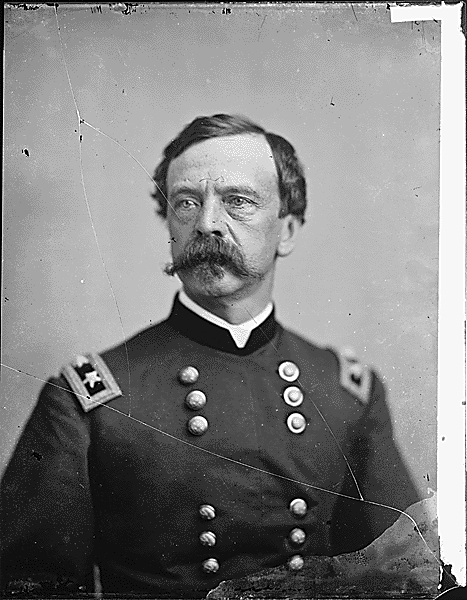
Major General Daniel E. Sickles
Of course, the book talked about Maj. Gen. Daniel Edgar Sickles (who I’vementionedbefore) and his role as commander of the III Corps of the Union Army of the Potomac at the Battle of Gettysburg. As you may have learned from my previous posts about Sickles, he suffered a serious wound on his right leg during the battle (as happens when a 12-lb cannon ball hits one’s shin) and had to have the lower part of that leg amputated.
My childhood Time-Life book describes his wounding and tells the story of how Sickles (knowing of the Army medical service’s new training and education initiative) used his political influence to have the bones from his amputated leg sent to the newly-created Army Medical Museum to be made part of their collection. Creepy as it may seem, he became a regular visitor at the museum, and would use the opportunity to spend some quality time with his lost appendage.
The Army Medical Museum no longer exists as an institution, but it has morphed into the National Museum of Health and Medicine and moved around a few times. The current building is in Silver Spring, MD just north of Washington, D.C. About a month ago, I found out that they were going to have a living history encampment at the museum, and I thought that would be a fun day for me and little John. I ended up inviting my friend John Dolan, and my mother-in-law along, too. My wife, sadly, had to work that day.
It’s a good, if somewhat small, museum. There are a number of examples of gruesome injuries on display – mostly from the Civil War era. They also have some artifacts from Presidential deaths. Slices of U.S. Grant’s tumor are displayed on slides in one of the cases, alongside the bullet-holed spine of James Garfield. There is also a collection of artifacts from Lincoln’s autopsy including small pieces of his skull, and the bullet that killed him. All of this in a free museum! If you’re visiting the Washington, D.C. area, and have any interest at all in medical history, it’s well worth the trip.
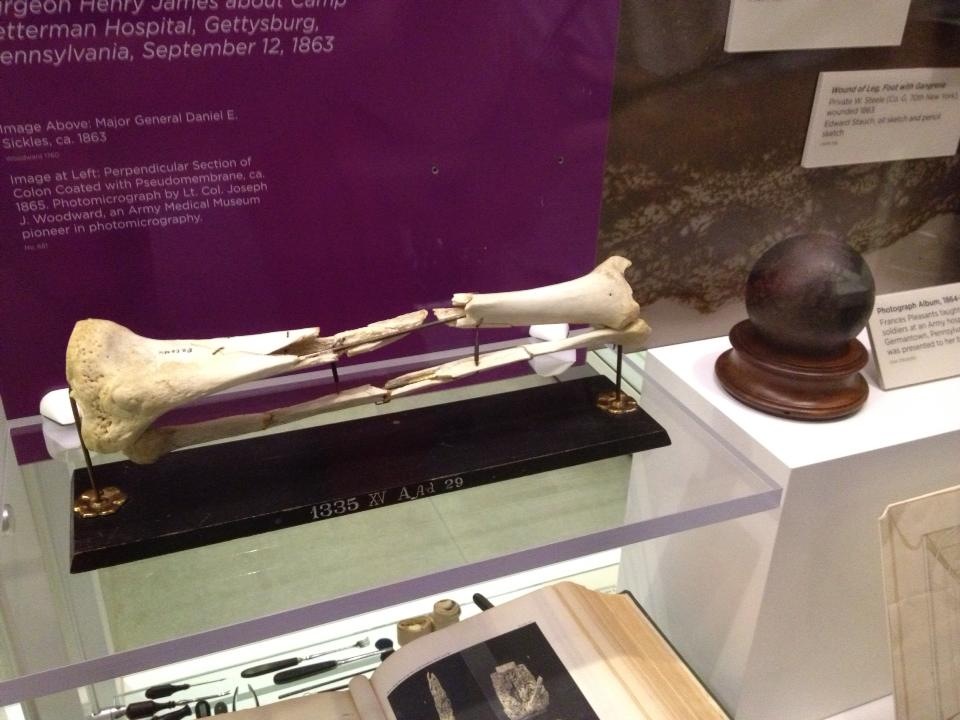
Toward the back of the museum is what I came to see: General Sickles’ leg along with an example of the type of artillery round that caused the wound.
Sickles’ amputated leg
As far as I know, the leg has been displayed like this – semi-reassembled with the metal rods and the wooden base – for years. At least in the new museum, it doesn’t really have a flashy, special place. If you weren’t looking for it, you’d probably miss it.
Since I had heard the story of the leg since I was a kid, I couldn’t resist the chance to get a picture with it. I’m left wondering whether Sickles himself – eccentric old character that he was – ever did something similar.
This is a continuation of a series of posts that are intended to be shorter, more understandable versions of the Federalist Papers. This post deals with Federalist #26, the original text of which can be read here: http://thomas.loc.gov/home/histdox/fed_26.html
Originally published December 22, 1787 by “Publius” – who was in this case, Alexander Hamilton.
It was a surprise when the revolution ended up bringing us to a place right between POWER and PRIVILEGE, trying to keep our rights while giving the government some power. We didn’t get it quite right though, and that has been the source of our trouble. This mistake should be corrected, or else our future attempts to fix it won’t really change anything at all.
Removing government power over the military sounds like a better idea than it actually is. Even though we seem to have invented the concept, we aren’t really employing it ourselves – only Pennsylvania and North Carolina have – everyone else refuses to consider it, and really they are right. You have to trust someone, and it’s a better idea to take the risk of abuse-of-power, than to leave us in a state where the government can’t protect us. Those who oppose the Constitution are at odds with the majority in this regard, and rather than moderating their own views, they want to drive us deeper into extremes. They recommend a solution that has been flatly rejected before, and frankly, they’d make this country ungovernable. It’s a good thing that won’t happen – the people are too smart for that. We know how important a sufficiently powerful government is. I’m sure of that.
But where does this idea come from? You might think it came about because history teaches us about the tendency for military encroachments on freedom. It actually comes from England.
Their King had almost total power for centuries. Over time, that power was eroded away by the aristocracy and the people to the point that there’s no real danger left. Eventually, the English Glorious Revolution secured this arrangement permanently. Various monarchs had kept troops – in increasing numbers – for their own purposes over the years. The Bill of Rights made it illegal for standing armies to exist without Parliament’s permission.
Even at the height of awareness of liberty in England, they had the good sense to not restrict the power of the legislature over the military. They understood that troops were necessary for emergencies that might come up, and they knew that the legislature was the safest place for the military power to be held.
Since we come from England, we’ve grown up in this same fear of standing armies. We got so caught up in the Revolution that we’ve gone too far in a few instances (like Pennsylvania and North Carolina did above). We mistakenly extended our fears from the King to the legislature, and put unnecessary provisions in some of our State constitutions. Of course the power to raise armies should belong only to the legislature – it goes without saying! The constitution of New York (clearly one of the greatest) says absolutely nothing about the subject.
Even in the two States that seem to fix the problem, they only say that standing armies shouldn’t be kept in time of peace, not that they can’t be kept. In using this wording, it’s obvious that the authors realized that a total prohibition would be a dangerous thing.
And of course, isn’t it true that any prohibition would be read as merely a suggestion if a crisis came up? What use would any of this language be if it was simply ignored when “necessary”?
So how is the situation different with the proposed Constitution? In the government it creates we do have a limit (though a perfectly reasonable one) that Congress can only set aside money for an army for a 2-year period. Since this isn’t anywhere near as extreme as a total prohibition on standing armies, it is more likely to be followed and have the desired effect.
This rule basically forces the Congress to discuss and vote on whether we need to have an army at least once every 2 years. They aren’t allowed to give the President a blank check for the military (even if they’re dumb enough to want to). This also forces the majority party to be open about what it is doing with both the people and the States. It would be hard to continue a tyranny for very long under this system.
In order to have a military build-up strong enough to threaten the people’s freedom, it would take a long time and require the constant cooperation of both the Congress and the President. It’s unlikely that such a coalition would survive for long with elections in Congress every 2 years. Would every new member of Congress instantly play along with the conspiracy and not raise the alarm? If you’re afraid of that, we can’t have any kind of federal system at all.
Even if a conspiracy like this began, it wouldn’t remain hidden. It would become obvious when the size of the army is being increased every 2 years. As soon as people know what is going on, the scheme will be finished.
Some people will argue that the President wouldn’t need the support of Congress once he has a sizable army – he can merely raid the countryside for supplies. But of course, how would he get an army that big in the first place? They’ll tell you that an army raised to counter a threat may stick around and be used against the people, but aren’t they really arguing that we shouldn’t ever have an army to defend ourselves? If we legitimately need a huge army to counter a specific threat, there’s really no way to prevent it from being used to attack freedom. No government can totally stop that.
But this isn’t really a concern for us as a united country. I can’t imagine a situation where the entire country was under attack at once, and we therefore needed a massive army (that would also threaten our freedom) to protect us. Especially when you consider that we’ll still have a militia. If we don’t go for a Union though, it’s almost inevitable that our liberty would constantly be threatened by the military (as we discussed before).
Earlier this week, a friend sent me a photo that she took at Monocacy. She knows that I’m interested in Civil War battlefields, and that I have a collection of photos that my friends and I have taken over the years on my work computer that I use when my screen is locked.
It got me thinking though – I’ve never been to Monocacy. I go to Gettysburg constantly. I’ve been to Antietam and Manassas a few times. I’ve even started to branch out to the Fredericksburg / Spotsylvania battlefields. But I’ve never been to Monocacy, and it’s closer to my house than any of those other fields. Since my wife was working this weekend, and I’d have to watch John anyway, I figured that we might as well have an adventure.
I wanted to do my homework first. I went looking for information about the battle in my “new” Time-Life Civil War books. Strategically, I thought the Battle of Monocacy was part of the Overland Campaign, but there was no mention of Monocacy in the book that covers it. No mention in the book about the Petersburg siege either. It wasn’t until I checked the book about the Shenandoah Valley that I found info. While Early did travel to Maryland via the valley, I don’t think I’d consider his move a part of those campaigns. Regardless, there was a decent overview of the action, and it gave enough context that I wouldn’t be lost when I got to the field.
The basics are these: The Confederate Army of Northern Virginia has been bottled up in the defenses of Petersburg, VA following Grant’s horribly bloody Overland Campaign. In an attempt to relieve some of the pressure of the siege, Lee sends Lt. Gen. Jubal Early with 15,000 men, north to threaten Washington, DC. Since the capital’s defenses had been more-or-less cleared-out to strengthen Grant’s army, Early didn’t expect much resistance. Major Gen. Lew Wallace, commanding the Middle Department, called for help from all quarters. He was able to pull together about 6,600 troops from militia units, emergency volunteers, and even the Washington defenses, and set out toward Frederick hoping to meet the advancing Confederates. Wallace knew he didn’t have much of a chance to defeat Early’s overwhelming number of battle-hardened troops, but he hoped to do exactly what he ended up doing – delay Early’s advance long enough for the reinforcements that Grant was sending to arrive in the capital.
Armed with my basic understanding, I packed John up this morning and got on the road west to Frederick after lunch. It took less than 45 minutes to get to the visitor center.
Now this was a pretty small battle by Civil War standards – only about 20,000 troops in total were engaged, and there were less than 25 cannons present between the two armies, so I went into this experience not expecting any artillery nerdery. My arrival at the visitor center got my hopes up though:
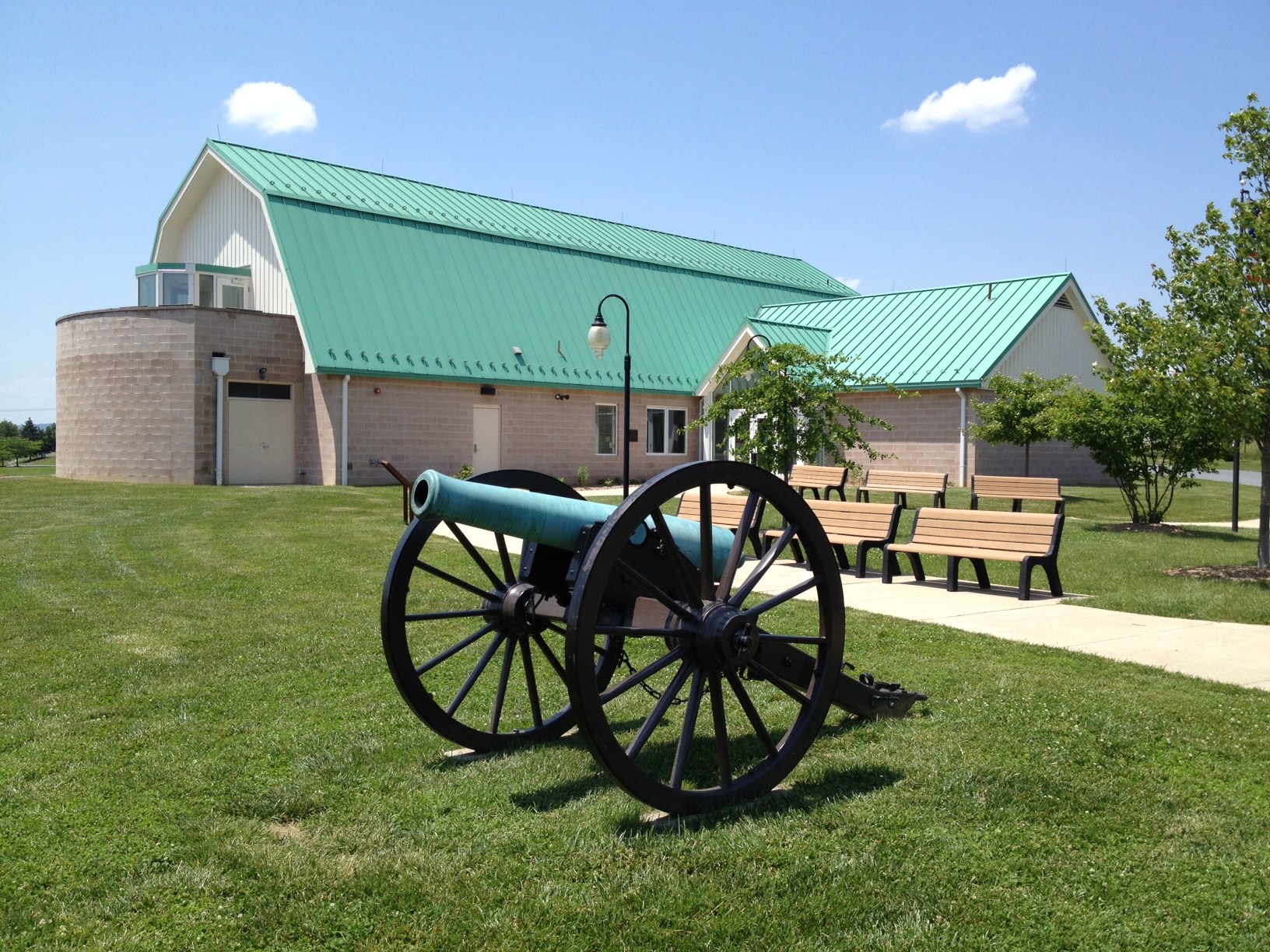
Revere Napoleon#46 in front of the visitor center.
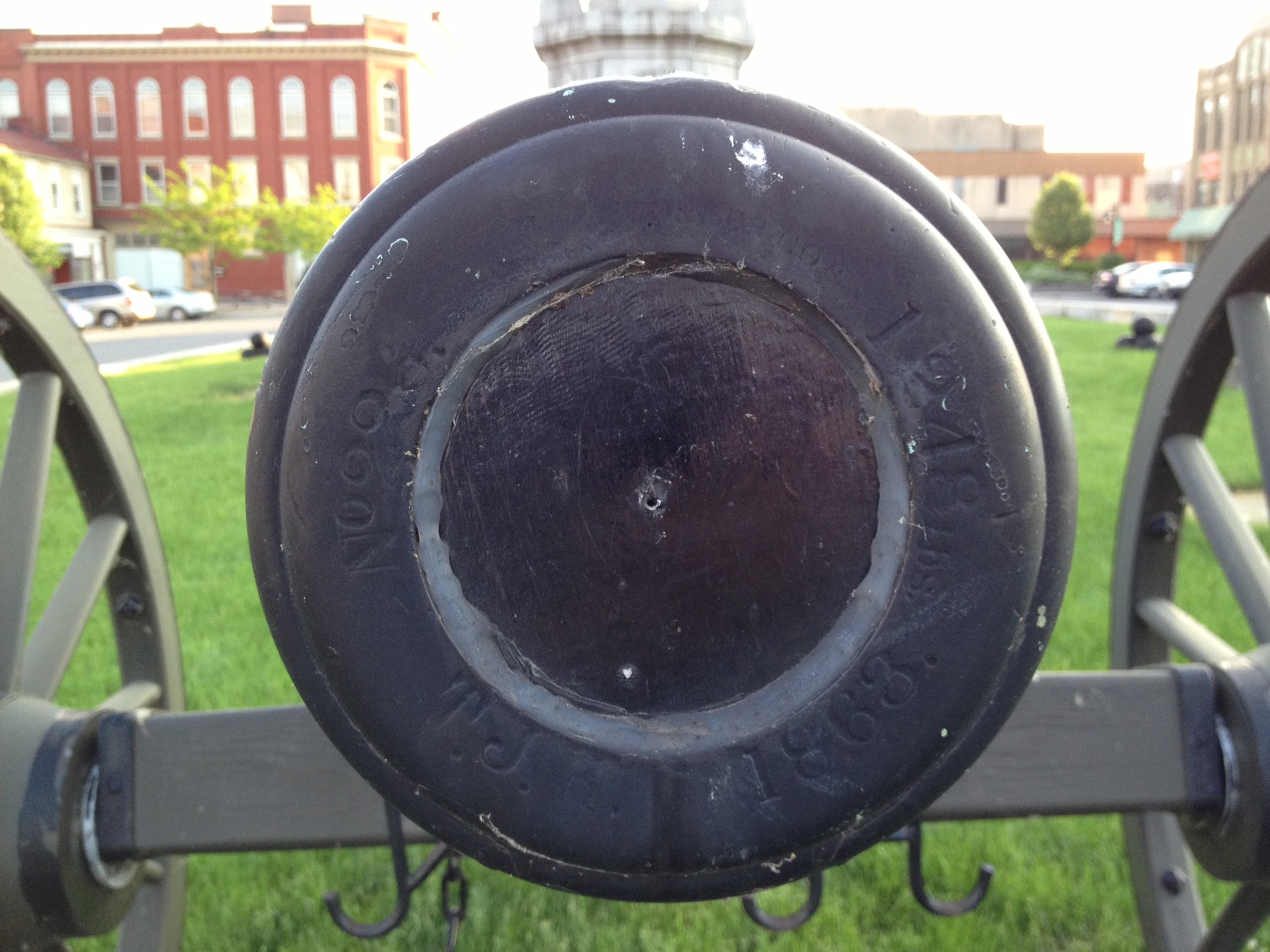
Between the parking lot and the building itself, there’s a real, live Napoleon, and it’s a Revere. The muzzle markings are in fine shape and are as follows:
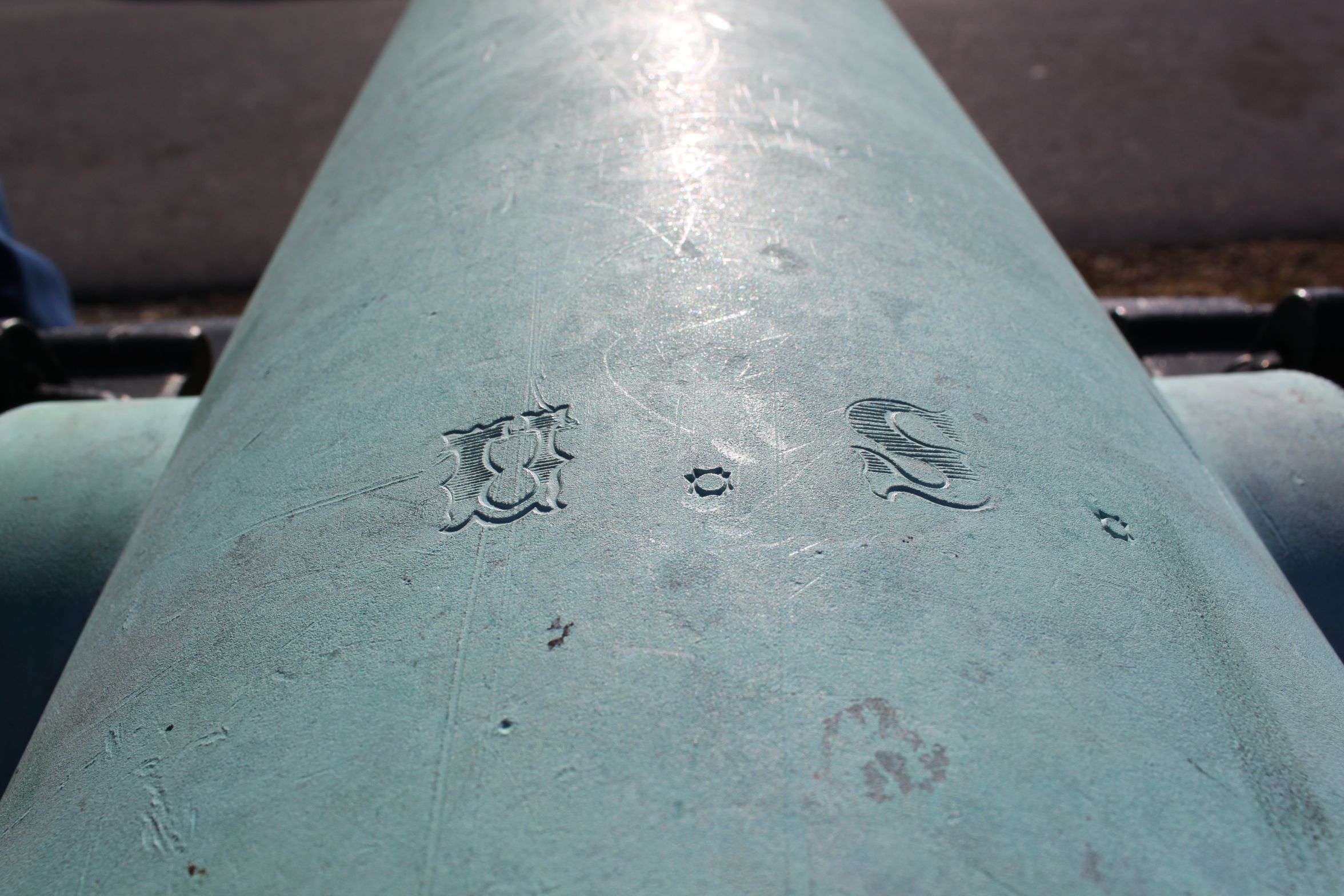
My source shows this weapon as being held by the Antietam National Battlefield a few miles down the road, so this piece must have been recently transferred. That happens from time to time. According to the Register of Inspections, this gun was accepted into service on May 20, 1862, so not only would it have been on the field in time for Gettysburg, but for Antietam, too – which is probably why they were the owners of the piece at one time. Like the other Reveres, it has the ornate “U.S.” acceptance mark on the top of the barrel between the trunnions. This was fun (and unexpected) to see.
The visitor center is on the small side – it’s comparable in size to Chancellorsville’s. There’s an information desk and gift shop on the main floor, and museum exhibits upstairs. There’s more flashy interactive stuff there than actual artifacts, but it’s very well put-together. The whole building seems very new, although I’m not really sure when it was built.
I got my park map, and started out on the auto tour. One of the other nice things that the park management has put together is a downloadable audio component to complement the tour – it’s also sold as a CD in the visitor center for less than $3. Having that audio really made for a nice experience. Each of the 5 tour stops has about a 5 minute clip associated with it. Combined with well-produced wayside markers at each stop, and the fact that the battle only lasted for 1 day and didn’t have too many moving pieces, you can easily get a good understanding of what happened here back in 1864.
I had to do an artillery-related double-take at tour stop 1, though:
“Napoleon” at the Best Farm.
From a distance, I saw a bronze-colored Napoleon. I’ve never seen this on a battlefield before (outside of a gun brought by re-enactors). This is what the guns would have actually looked like during the war – the familiar greenish patina on the bronze weapons is what happens to copper when it “rusts”. Was this an extremely well-kept Napoleon?
Sadly, no. On closer inspection, it was obvious that this was an iron weapon that had been painted a bronze color – there were areas on the gun where the paint had chipped and you could see black (or even rust) underneath. There are no markings on the trunnions, rimbases, or muzzle. These are clearly reproduction guns meant only for display. While that’s disappointing, it’s nice to see a gun presented to the public on a battlefield, looking the way it would have looked at the battle. I’m a little torn on this.
I saw one other reproduction gun like this one on the Worthington Farm (stop 3 on the tour), and no other weapons anywhere on the field. That’s a pretty accurate portrayal of the artillery at this battle so far as I can tell.
Monument to 14th NJ near Monocacy Junction.
It’s a similar situation for monuments. While explanatory waysides were plentiful, I counted only 5 commemorative monuments. One of these – and certainly the grandest one – was a monument to the 14th New Jersey Infantry, which became known as the “Monocacy Regiment” because it had served in this area early in the war defending the railroads, and then returned after a stint with Grant in the Overland Campaign to defend it once again. While I haven’t established a full service history for him yet, I’ve known that a distant cousin, John B. Skillman, served with the 14th NJ at some point during the war. Since it would be a family connection to this battle, and since my infant son is named John, too, this may be one of those things that I need to research further.
Other monuments include one placed by the United Daughters of the Confederacy next to a more descriptive one placed by the State of Maryland. There are also two other unit monuments: one remembering the 87th Pennsylvania, and another across the road for the 10th Vermont. None of these is easy to visit because of parking challenges, though.
There are a few walking trails on the property, and from what I can tell on the maps and from looking at the ground in person, they look like they’d be nice. Several of them go right down to the Monocacy river. The scenery is peaceful, and there’s plenty of interesting old farm buildings, too. It was oppressively hot today, and I didn’t have a good way of carrying John with me, so I didn’t attempt to walk them myself.
All-in-all, I’m glad I went to see the field. To my mind, it’s a relatively minor and simplistic engagement tactically, but it does end up buying time to bolster the defenses of Washington, DC – stifling any chance that the Confederates had of creating serious political problems for Lincoln right before the 1864 election. In this light, it is strategically important to the war, and a strategic Union victory.
It’s worth taking a couple hours to pay tribute to the men who fought here and learn a little about this part of our history.
After the funeral, Grandma wanted to sort through some of the things Grandpa had kept in his office for years. He had an extensive collection of books, housed on shelves he made himself. The orders from Grandma were: any books that family members didn’t want were being donated to the library. Naturally, we all took a look.
My Uncle Tom from Canada wanted the Time-Life World War II collection. My dad and I split the Baltimore-related books (more on that in a minute). Near the top of one of the shelves, I found a collection of electrical engineering textbooks that I can only assume he used during his training in the Navy. They don’t seem like they’d be very old – they’re only from the 1930s – but one of the books admits right up front that we don’t really understand a lot about electricity, but that it is probably the result of a “tension or strain” in the “ether“. My how far we’ve come, huh? I had to take those.
Grandpa’s Electrical Engineering Textbooks.
I was also lucky enough to be given my Grandpa’s entire Time-Life Civil War collection. I had the Gettysburg one as a kid, and I really beat it up, but boy did I love that book. I haven’t dug too deep yet, but the rest of the collection looks just as good.
The Time-Life Civil War Collection.
Apart from books, there were some other valuable items: ship models, hats, old liquor bottles, carved wooden masks, and lamps. Many of the gathered family members were able to find something that was meaningful to them.
My dad was looking for one thing in particular: the family records. I didn’t know what the big deal was. I have an Ancestry.com membership. Distant Cousin Bill Skillman has assembled a very complete family tree. What’s so special about these records?
I found out as soon as my Cousin Kyle found a box near the bottom of the closet with my dad’s name on it. Apparently, Grandpa knew that my dad would want to be the keeper of the records. Inside was a hand-written family tree (in pencil) on the back of Skillman Baking Company paper. I haven’t had a chance to really examine it myself yet, but it looks amazing. I have no idea who wrote it, but it has to be at least 100 years old.
Another box was labeled “Mother Skillman”. I can only assume that this refers to my Grandpa’s mom, Sophie (Jory) Skillman. This box had a ton of pictures and letters in it. I also haven’t gone through all of it – we left it with my Grandma in Lewistown. There were two things that I took from that box though, and tonight I scanned them so they can be preserved.
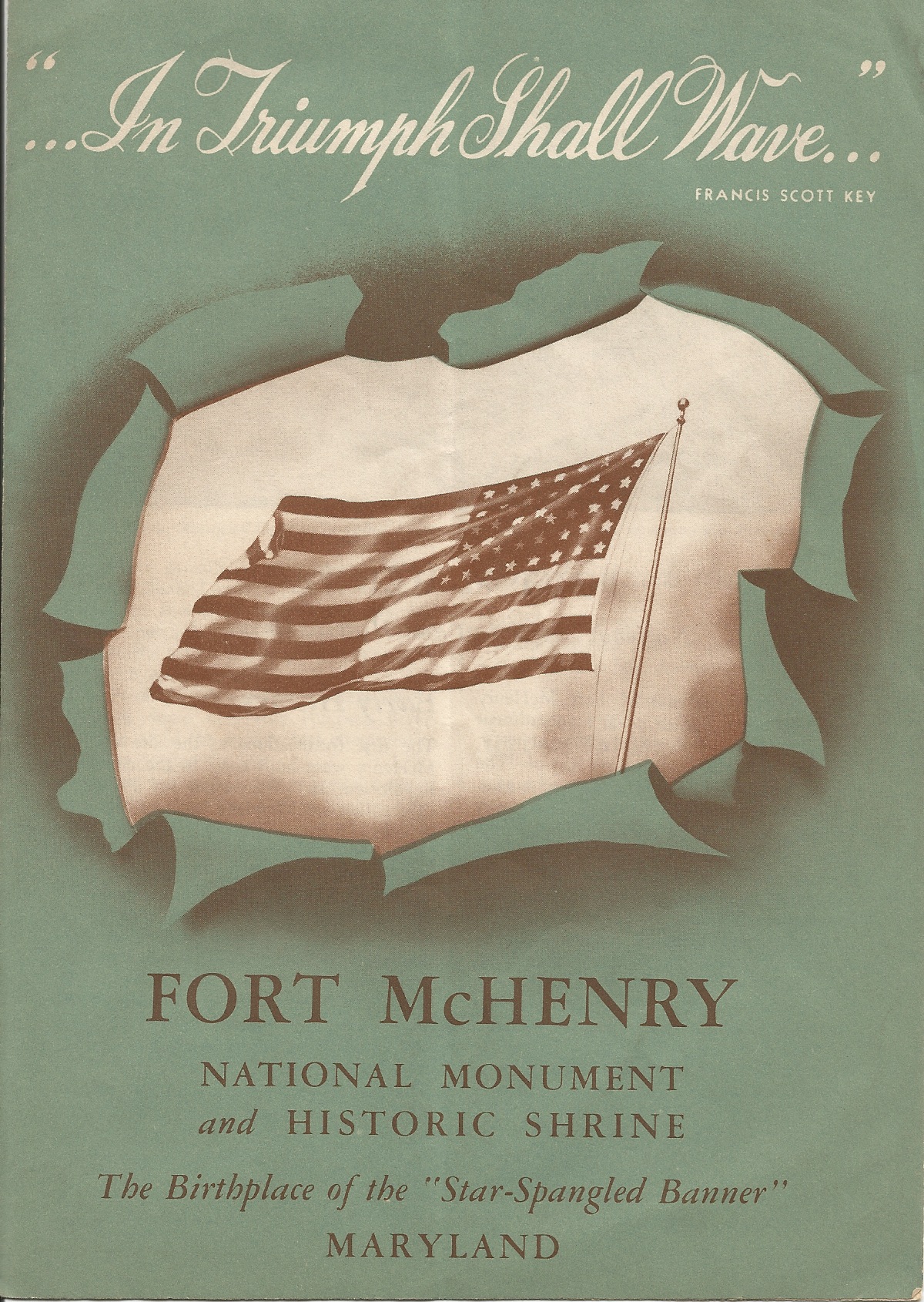
1940s Fort McHenry Brochure.
One is an old brochure from Ft. McHenry National Monument and Historic Shrine. I’ve collected quite a few of these myself over the years, but none as old as this one. Based on the the fact that Harold L. Ickes is listed as being Secretary of the Interior, and Newton B. Drury is listed as the Director of the National Park Service, the brochure would have to have been produced between 1940 and 1946. I guess my Great-Grandmother must have gone down the avenue (she lived at 1604 Johnson Street in Baltimore) to visit the fort sometime during those years.
It’s a cool document. Admission was $0.10 back then. The cover features a 48-star U.S. flag (shouldn’t it always be a Star-Spangled Banner?). I’m amazed that both my Great-Grandmother and then my Grandpa decided to keep this brochure around for all these years. Why? Was this a memento of a special visit for them? Was it just a familiar reminder of Baltimore for my Grandpa? I’ll probably never know.
Either way, I created a high-quality PDF of the brochure to preserve and share it. Feel free to have a look for yourself. See what the past thought of the past.
The other item from the box is equally interesting. My Great-Grandmother kept a small book (it’s more like a pamphlet) of photos from the 1904 Baltimore Fire. As best as I can tell, the book itself dates from 1904. Obviously, this was a major event in her life. Looking at the photos, you can see that the devastation was almost unbelievable. This story isn’t much told – even locally in Baltimore. We should try to change that.
Cover of my Great-Grandmother’s Baltimore Fire book.
The cover announces that there was $175,000,000 of damage. That’s over $4.4 Billion in today’s dollars.
This is just a taste – I’m sure there’s plenty more in those boxes up in Lewistown. I’m so excited to see what else is waiting up there for us to discover.
Thanks for keeping this stuff around, Grandpa.
UPDATE: I’ve replaced the PDFs with much smaller versions (filesize-wise) that my dad created from my originals.
While I was up in Lewistown, PA for my grandfather’s funeral, I took a ride around town with my dad to get some photos of a few of the downtown buildings. My dad got some great nighttime shots, but I turned out to be more interested in getting some daytime shots yesterday, because the dominant feature in the town square is a Civil War monument with some guns on display surrounding it. I had to get a better look at that artillery!
All the guns in the square are real weapons, but two of them may not have ever been fired in anger. We’ll start with those:
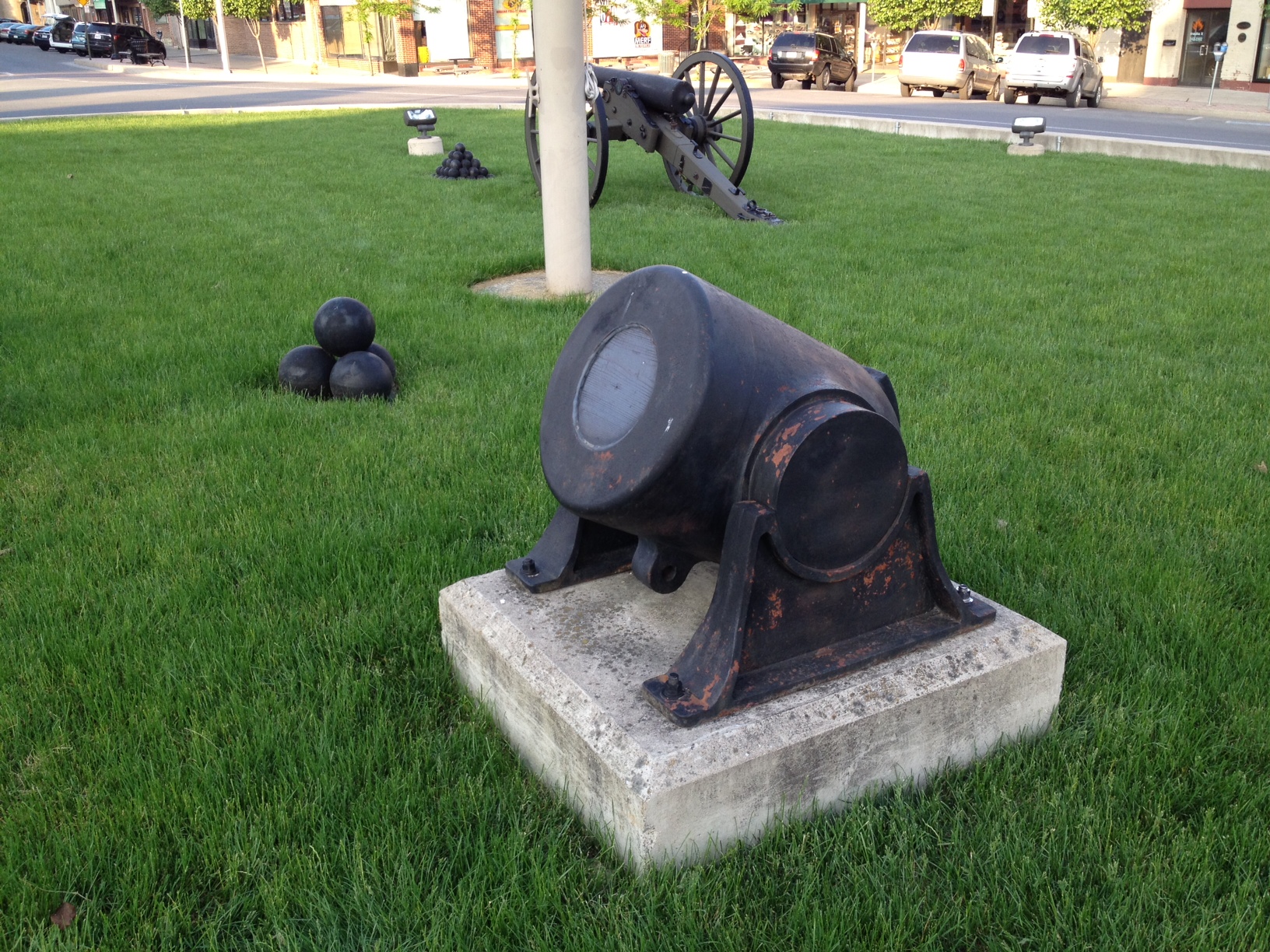
10-inch Siege Mortars in Memorial Square
On each of the “skinny” sides of the square (the northwest, and southeast fronts) there are 10-inch siege mortars on display. You can see in the picture above a protrusion from the “bottom” of the weapon with a hole through it – this was used to lift the weapon from its mounts. That being said, it should be on the top – these weapons are mounted upside-down. The stats for both weapons are below:
“Northwest” Mortar
Manufacturer – S. McM. & Co.
Year Built – 1865
Serial Number – 7
Weight – 1950 lbs
Inspector – S.C.L.
“Southeast” Mortar
Manufacturer – S. McM. & Co.
Year Built – 1865
Serial Number – 23
Weight – 1959 lbs
Inspector – S.C.L.
The manufacturer of these weapons is listed on the muzzle as “S. McM. & Co.” this stands for Seyfert, McManus & Company, which made several different models of heavy siege guns for the U.S. Army in Reading, PA about 100 miles or so east of where the guns rest today. They were inspected by “S.C.L.”, or US Army Ordinance officer, Stephen Carr Lyford. Since these weapons were made in 1865, and the war ended in April of that year, I doubt these ever saw active service – they were probably made to fulfill a contract. If either of them did make it to the field, it would probably be the #7 one.
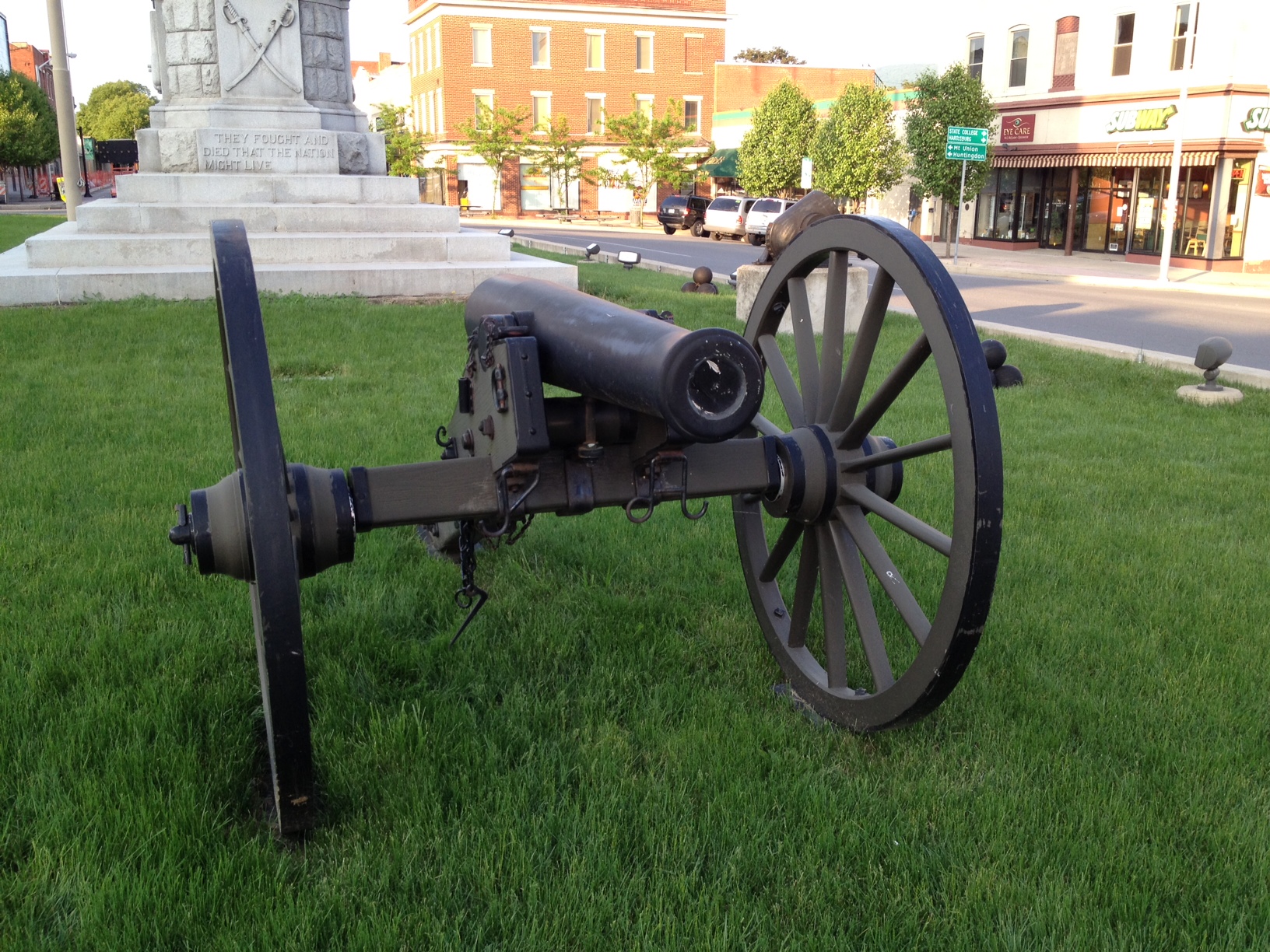
The other weapons in the square are what I was really interested in. These were 12-pounder Napoleons that someone – for some unknown reason – decided to paint black, forever destroying their beautiful bronze patina (though some streaky green shows through a little bit). This is especially sad, I’m sure, for one of these guns.
Ames Napoleon
The first of these guns is on the southwest side of the square. Despite being painted black, its markings are still plainly visible:
Muzzle Markings on the Ames
Manufacturer – A. M. Co.
Year Built – 1862
Serial Number – 58
Weight – 1224 lbs
Inspector – A. R. D.
As you can see, this gun is exciting for me because it’s certainly possible that it was at Gettysburg. There were 244 12-pounder Napoleons at Gettysburg on both sides, and since this gun was made sometime in 1862 (the Register of Inspections shows that it was inspected and accepted into Federal service on May 31, 1862), it’s absolutely a sure thing that it would have made it to the field by the summer of 1863. The only question is whether this gun went to one of the eastern or western armies. “A. M. Co.” is an abbreviation for Ames Manufacturing Company which still exists today. In fact, you may have used their more recent products in your garden. Their cannon manufacturing operations were headquartered in Chicopee, MA just north of the US Armory at Springfield. The inspector for this piece was Alexander Brydie Dyer, who was the commander of the Springfield armory at the time.
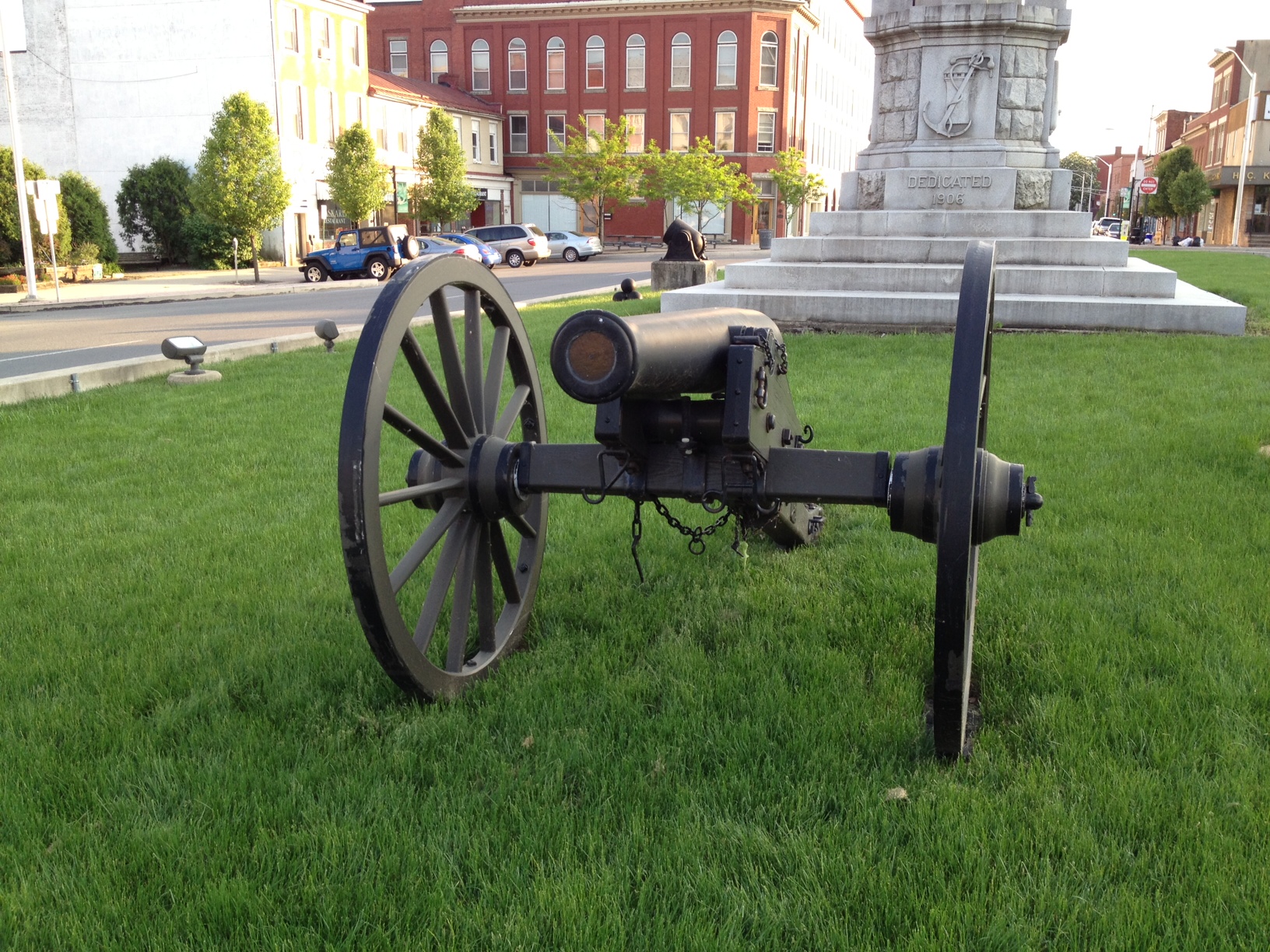
The second Napoleon, on the northeast side, is the one that makes the black paint especially sad. That one is a Revere:
Revere Napoleon
It is gut-wrenching to see this gun painted-over. Every one of the Revere Napoleons that I’ve ever seen has the most beautiful, bright, consistent green patina. It’s the mark of extremely high-quality metals and processes being used to make them. For a reason I will never understand, the people in Lewistown decided that these guns would be better off hiding their brilliant craftsmanship and masquerading as iron weapons.
Despite the abysmally ugly black paint, the markings on the Revere Napoleon here are in great shape:
Muzzle Markings on the Revere
Manufacturer – Revere Copper Co.
Year Built – 1863
Serial Number – 226
Weight – 1248 lbs
Inspector – T. J. R.
Once again, we have a gun that could have been at Gettysburg. The Register of Inspections is unclear on this particular serial number, but given the pattern of inspections from previous months, this gun was probably accepted into Federal service sometime in February of 1863, giving it enough time to have made it to the field by that summer. We still have the east or west question just like the Ames Napoleon above, too. The inspector, Thomas J. Rodman – the inventor of the Rodman Gun, and a more efficient type of gunpowder – is one of those legendary ordinance officers in the Civil War.
I’m going to try to dig into these pieces a little further to see if I can find any definitive service history for these serial numbers, but I doubt that any such document exists. We’re left to speculate by ourselves about the work these guns might have done 150 years ago.
WARNING: This post is going to basically be a diary entry about my Grandfather’s funeral and the events surrounding it. While this will probably only be of interest to family members, I just wanted to record it somewhere. I’ll make some other posts about historically-interesting things soon.
As I suppose people do, our family went into planning mode when we found out very early Friday that my grandfather had passed away. The funeral was scheduled for Monday morning, and we had to make the family come together in Lewistown, PA.
My immediate family – including my wife and son, my parents, my brother and his wife, all made plans to go up Sunday and spend the day with whatever other family members were there. As it turned out, there was quite a lot of company – my Uncle Dave and Aunt Dawn had driven from Illinois. My Aunt Marty made the trip from New Jersey. Uncle Rob and Aunt Faye live in town, and of course so does Grandma.
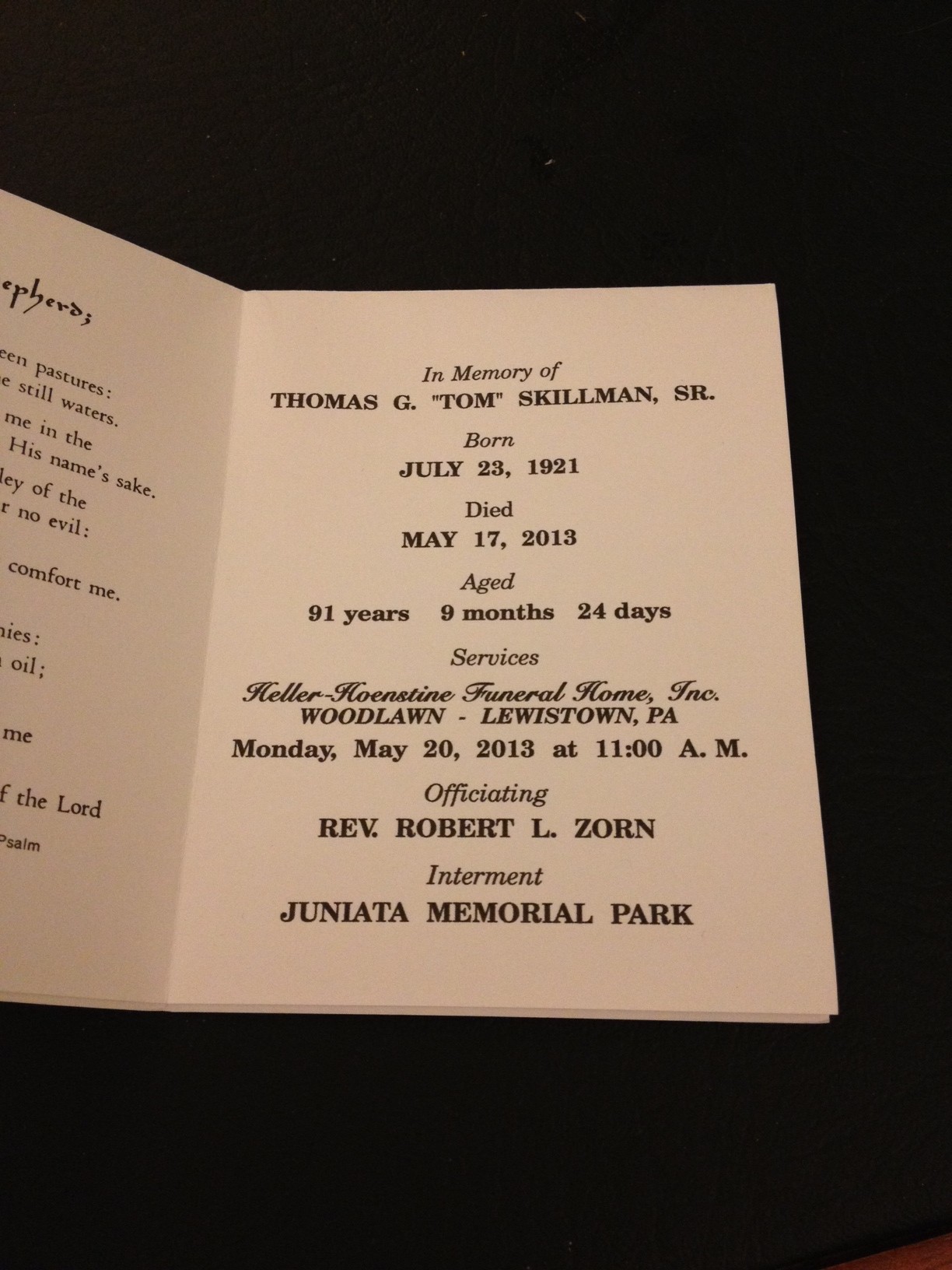
Grandpa’s Prayer Card.
We all met up at Grandma’s house, and after a brief visit, went over to the funeral home for a 5:00pm private viewing for the family. I suppose the people at the funeral home want to make sure that everything is set up the way the family likes. I didn’t take any pictures at this stage, but it was very well done, as usual – both of my grandma’s parents, as well as both of my maternal grandparents, used the services of this home, so we are very familiar with their work – sad as that may be.
The whole family went back to Grandma’s house to make sandwiches and just visit for a little while. It was a really nice time. Isn’t it a shame that you never get together with family from all across the country until there’s a death? We just don’t make enough time for things like that. Since we all wanted Grandma to try and get some rest, we left around 8:00pm and went over to the hotel.
Grandpa’s name listed at the funeral home.
In the morning, we got ready and met up in the lobby. It turns out that Aunt Holly and Cousin Kyle had made the trip down from Canada and arrived late Sunday night. The whole family left together so that we could get to the funeral home by 9:30am. Once we got there, we met up with my cousin Michele (Uncle Dave’s daughter) and her husband Tim who had driven up from the eastern shore of Maryland.
We got our cars in order for the procession to the gravesite, and then went inside for the public viewing. There were pictures of Grandpa set out, and some flowers that family members had ordered were displayed near the casket. It was as nice an atmosphere as you can have for an event like that, I suppose.
Lots of people showed up for the viewing – more than I was expecting from the way Grandma talked about it anyway. My Grandpa had quite a full life, and that was represented by the folks who came to see him. There were friends from his days in the local police force, people he knew from church, and representatives from the VFW (as my Grandpa had served on the USS Alabama during the closing days of WWII).
Family gathered for Grandpa’s funeral.
The service itself was very nice. Rev. Robert Zorn, the pastor from my Grandparents’ church, did some readings and had some nice things to say about Grandpa. He regularly spent Monday mornings visiting with him out at the Malta Home, so he had a few stories to tell. My Uncle Dave eulogized Grandpa, and while he announced that he was nervous about his ability to get through that experience, he didn’t waiver at all. A friend of my Grandpa’s, Tom Gross, gave a lively and entertaining tribute – if a funeral can have such a thing, Tom was the life of the party.
Finally, it was time to go to the graveside. We wound through Lewistown, and out to Juniata Memorial Cemetery where the VFW representatives, and Grandpa’s flag-draped casket were waiting for us.
Grandpa’s graveside service.
Rev. Zorn said a few words and then turned it over to the VFW honor guard who performed a flag-folding ceremony. My Grandma was given his flag and a few words of kind gratitude – an all too familiar scene. There was a rifle salute (which scared little John to the point of tears), and the playing of Taps (which seemed to soothe my son).
Dismissed from the graveside, we all met back at the church for a fried chicken lunch and some time to relax and share memories. I think we’re all grateful to the church ladies for making that happen.
Eventually, we found our way back to Grandma’s house to visit some more and to start going through the things that Grandpa left behind. Grandma wants to get his old office cleared out of books and miscellaneous papers, and in the process of starting that, we stumbled onto a treasure-trove of family history that we’ll have to go back up and start to catalog. I’ll share my initial impressions of that family history in a follow-up post.
UPDATE: I’ve added a scan I made yesterday of the Lewistown Sentinels‘ Obituary for Grandpa as a PDF.
This is a continuation of a series of posts that are intended to be shorter, more understandable versions of the Federalist Papers. This post deals with Federalist #25, the original text of which can be read here: http://thomas.loc.gov/home/histdox/fed_25.html
Originally published December 21, 1787 by “Publius” – who was in this case, Alexander Hamilton.
Some people might suggest that the States (while taking direction from the Federal government) should have responsibility for the common defense. The problem with this idea is that it throws the whole system on its head. Not only is it potentially dangerous and burdensome for the States to handle this task, it defeats the purpose of having a Union in the first place.
We are surrounded by foreign nations – it’s not like only specific States are on the borders. All the States face the same danger, so why not have a common government to deal with them? There are some States that face a slightly higher danger and therefore have more responsibility to defend their neighbors (like New York because of its long border with Canada) – this burden isn’t fair to New York, though. And if New York isn’t up to the task of defending that whole border by itself (which it isn’t) that puts every other State in jeopardy, too. Even if New York was up to the task, wouldn’t it be trouble for one State to have such an over-powering military all to itself? Wouldn’t its neighbors be nervous enough that they might build larger military forces than they actually need to counter the threat from other States? It isn’t hard to see how this could lead to friction amongst ourselves. There are a lot of things that are bad about this idea.
We’ve already discussed that the States will be fighting for power with the Federal government regularly. In any such conflict, the local government will probably win out. If those governments also control their own militaries, they would certainly have too much power against the Federal government. It’s also going to be worse for the freedom of the people. It’s better to have the military be under the control of the Federal government (which the people are more likely to be skeptical of) than under the individual States. History teaches us that the most dangerous people are the ones that we trust.
With the understanding that heavily-armed States would be dangerous to the Union, the framers of the Articles of Confederation restricted the States from having armies and navies. In reality, this rule is effectively ignored just like the quota system for revenue.
There are other issues with this idea, too. What proponents of it are trying to do is prevent standing armies during peacetime. But does this prohibit raising armies as well as maintaining them? If it applies to maintaining, how is that going to be determined? Are they only allowed to be maintained for a brief period, or until the crisis is over? Under such a system, couldn’t armies exist in times of peace, and if so, wouldn’t that go against the literal words of the prohibition? Who is going to be the judge of what “time of peace” means? Obviously the Federal government would have to be the judge of this, so how much of a restriction would this be really, if it can be circumvented so easily?
The only thing this is defending against, in reality, is the unlikely event that the legislature and the executive co-operate to make trouble. And if that happened, it would be extremely easy to come up with phantom threats that we need to defend against. The Native-American tribes (incited by Britain or Spain) will be a ready scapegoat. Such a diabolical government may even nudge those foreign powers into making the first attack.
We could restrict the Federal government from raising an army during peacetime, but then, we’d just be creating a country that can’t even prepare to defend itself against an imminent invasion. Formal declarations of war aren’t always issued. We may not know that we’re at war until we’re invaded, and we may not legally be able to even prepare to act until it’s too late. All the preventative and preparatory measures that other countries use would be illegal for ours. Our homes and freedoms would be at the mercy of any foreign nation – and all because we don’t trust the people we chose to run our own country!
People might counter that the militia should be the rightful, able, and ready defenders of the country. But we know from our experience in the Revolution that this isn’t true – we needed an army for our defense then, and we’d be stupid to give credence to that argument now. A militia is no match against a well-trained and well-equipped army. An army would be cheaper, too. During the Revolution, the militia performed great service, but they know that they couldn’t have done it alone. War can best be won by veteran soldiers who know what they’re doing.
Any policy of violence (because they just don’t work) will ultimately fail. Think of Pennsylvania – its constitution prevents it from having standing armies in peacetime, but it has raised one anyway because of small rebellions in a few of its counties. Or what about Massachusetts? it raised a force (that it has kept around to date) in order to deal with a similar insurrection without getting Congressional approval first like the Articles of Confederation require. This just goes to show, we may actually need a military force during peacetime – we shouldn’t absolutely prevent the legislature from having that option. And think of the lesson here – a weak Federal government isn’t going to be respected, and rules on paper aren’t going to mean anything if the people think they need something else.
Returning to history, it was an important aspect of the Lacedaemonian commonwealth that no one could be Admiral twice. But when the Peloponnesians had been beaten by the Athenians in a naval battle, they called for Lysander (who had led them to victory years before) to be given that title a second time. In order to get around the restriction, he was given the Admiral’s powers, but under the title Vice Admiral. This perfectly illustrates the point above – the rules will be broken if society thinks it should break them. If we’re smart, we won’t make rules that we know will be broken, because it will only lead to further infringements on the other laws whenever a politician claims that it is “necessary”.
This is a continuation of a series of posts that are intended to be shorter, more understandable versions of the Federalist Papers. This post deals with Federalist #24, the original text of which can be read here: http://thomas.loc.gov/home/histdox/fed_24.html
Originally published December 19, 1787 by “Publius” – who was in this case, Alexander Hamilton.
There is only one argument that I’ve heard against the military powers granted to the Federal government in the proposed Constitution, and that is that there doesn’t seem to be enough protection against the creation of standing armies. Let me speak to that point.
This objection is only vaguely asserted, with no real facts to back it up. It goes against the historical evidence of every other free nation, and against the general will of our citizens. It seems like what these people want is for us to limit the power of the legislature when it comes to military affairs. With the exception of a few State constitutions, this idea is almost unheard of, and nearly universally rejected.
If you were learning about our political system for the first time by reading the current newspapers, you’d think that either the proposed Constitution explicitly requires us to have a standing army, or that the power to decide whether we have one lies with the President – while Congress has no say in the matter.
Of course, if the same person read the actual proposed Constitution, he’d see how wrong this initial impression is. Congress (a body that is partly elected by the people themselves) has the power to raise armies, not the President. Congress’ power even has a caveat: that no appropriation of money can be made for the army for greater than a 2-year term. When you really look at it, this is a solid protection against an unnecessary standing army.
With this in mind, our hypothetical political neophyte might then assume that the fury of these objections is based on the fact that our citizens are so worried about their freedom, that their current (or previous) governments’ charters must have included very specific and explicit limitations on the formation of standing armies. The fact that those traditional, explicit limits have somehow been left out of this proposed Constitution is what all the fuss is about.
Naturally, he’d be led to look at the States’ constitutions for evidence to support his assumption. What he’d find is that only 2 of those charters put an explicit limitation on standing armies. The rest either don’t mention the subject at all, or explicitly allow them.
Even after all this, he might think, “Well there must be some reason for all this panic!” He wouldn’t be able to bring himself to think that this is all just political wrangling on the part of people who are opposed to the new Constitution. “The answer must be held in the Articles of Confederation”, he may say, “surely the specific prohibition of standing armies that is lacking in the proposed Constitution has to be contained there!”
Imagine his surprise to discover that while the Articles restricted the States in that capacity, they make no mention of preventing the Federal government from forming standing armies. At this point, it would become absolutely clear to him that this objection is rooted in nothing more than political show-boating and fear-mongering. If anything, this proposed Constitution provides better security against the danger, and it at least deserves a fair and honest hearing based on the facts. This hypothetical observer would have to conclude that it looks like the opponents of the proposed Constitution are more interested in misleading people with emotional appeals, rather than convincing them with rational arguments.
Even if there is no historical or popular support for our opponents’ point of view, it is still worth taking a closer look at. If we did put a more explicit limitation on the formation of standing armies, it would probably end up being harmful (if not outright ignored).
It’s true that we’re far from Europe, but even on this continent, we’ve got British territories to the north and Spanish ones to the south. Both have islands in the Caribbean. We have sometimes-aggressive Native-American tribes to our west who are likely to ally with the British or Spanish against us. Improvements in shipping and communication will in effect make the world smaller. These facts, combined with the knowledge that Britain and Spain have two of the best navies in the world, and that it isn’t totally improbable that an alliance may form between them in the future, you can see that critical danger may arise at any time.
We’ve had to keep a guard on our western border ever since the Revolution. Obviously we need to keep this up as a defense against the native tribes. How are we going to man those forts? Either with militia who are sent to the frontier – away from their homes, families and jobs (which would be at least impractical and expensive, if not outright dangerous) – or with a small standing army. We should leave these options open to the wisdom of the legislature, and not force them to go with the much more troublesome militia-only route.
As we become a stronger nation, Britain and Spain will probably start keeping more troops on the continent to look out for their own interests. It would be wise for us to have enough men available in our frontier forts to counter that threat. Some key places – either because of their military or commercial importance – should definitely be strongly occupied at all times in order to prevent them from being taken by our rivals.
If our economy continues to rely on trade – or even if we just want to protect our shores – we need to have a navy. With a navy comes a need for port facilities and seacoast forts. Eventually, once we get a stronger naval presence, we may be able to get rid of the coastal forts, but at the start they will be necessary to protect us.
This is a continuation of a series of posts that are intended to be shorter, more understandable versions of the Federalist Papers. This post deals with Federalist #23, the original text of which can be read here: http://thomas.loc.gov/home/histdox/fed_23.html
Originally published December 18, 1787 by “Publius” – who was in this case, Alexander Hamilton.
Let’s talk about why we need a government with at least as much power as the one the proposed Constitution sets up.
This is most easily presented in three parts (we’ll deal with how to organize and distribute its power later):
What should the government do for us?
What amount of power does it need to do those things?
Who is the “us” in the first question?
So, what are things that the federal government should do? Provide for the common defense – protecting us from foreign threats as well as domestic rebels; regulate interstate, as well as international trade; and finally, oversee all our diplomatic relations with other countries.
Our government can only provide for the common defense if it can also raise armies and maintain a navy, all the while providing material support, and control over them both. Because it is impossible to know exactly what kinds of military emergencies might come up, THERE SHOULD BE NO LIMITATIONS ON THIS POWER. If there are infinite types of danger, there should be infinite powers to meet them.
This truth is so obvious as to be self-evident, but if someone is expected to do a thing, he must be given enough power to actually accomplish it. I can’t make it any simpler than that.
Whether we should have a federal government to protect us at all is a fair question, but as soon as we decide that would should have one, it must be given enough power to actually be able to do its job. And unless the dangers to public safety can be defined as only being within certain limits, it is necessary for there to be no limit to the power of the federal government to create, control, and support the military.
As bad as the Articles of Confederation are, at least they acknowledge this fact (even though they didn’t really flesh it out fully). Congress was given the power to ask the States for men and money in support of an army, and to control that army. And given that the States are legally obligated to comply (even if they ignored that requirement much of the time), you can figure out that the intention was for the federal government to have any resources it needed to defend the individual States. You would think that the States would act in their own best interests and comply with those requests.
In practice, it obviously didn’t work out that way, and it should be clear to everyone that we need to totally re-think this system. If we’re serious about giving the federal government the power to defend us, we have to stop thinking about it as interacting only with the States – we have to give the federal government power over the individual citizens living within those States. The quotas are stupid and unfair, and we should get rid of them. In the end, the federal government needs to have total authority to raise armies and navies, and support them with taxes – the way all other governments do.
If we’re going to have a confederacy – rather than one national government – then we need to figure out how to divide up the powers between the States and federal governments. Is the federal government responsible for defense? Are armies and navies necessary for defense? If so, the federal government must control those. The same argument applies with commerce. It’s as simple as that. Should disputes between a State’s citizens be handled by that State? If so, the States need to have enough power to do that. If you don’t give the respective governments the power to do their jobs, you are unnecessarily handicapping them.
So who is best-equipped to provide for that defense? Isn’t it the government that is able to see, understand, and control the whole picture, and will be most likely to forcefully look out for everyone’s interests? It is madness to give the federal government the responsibility for defense, but leave the States with all the power needed to carry it out. Doesn’t this end with us sitting around wishing that the States would cooperate more? Leaving things how they are will only make us weaker, and our military less efficient, and the burden of it unfair. Isn’t this what we just got done dealing with during the Revolution?
The more we think about it, we have to admit that the federal government needs this power. Of course, it will be up to the people to ensure that this power isn’t abused, but any plan to fix our government that doesn’t include this power should be immediately rejected. If you can’t trust a government to do the fundamental thing that it should do, then you probably shouldn’t be installing that government in the first place. If you trust them to look out for you, you should be able to trust them with the power to do so. The opponents of the proposed Constitution are focusing on scaring you with the powers this new government has, when they should really be concerned with the structure of it. If it’s true that no government can be trusted with enough power to effectively govern a country our size, then we shouldn’t even try to make one, and just split up into separate confederacies right now. Otherwise, the paradox of demanding something that the government doesn’t have power to provide will become unbearable. Don’t try to work with the paradox – seize the logical solution.
I don’t think the other side can prove that this country is too large for a single government. I think I’ve made it pretty clear so far that the opposite is true: we need a central government, and the vast size of our country proves that we need one that is vested with enough power to govern it. If we listened to the people who rail against the proposed Constitution, we’d have to conclude that even the weak government created by the Articles of Confederation is too powerful for them.


 shows this weapon as being held by the Antietam National Battlefield a few miles down the road, so this piece must have been recently transferred. That happens from time to time. According to the Register of Inspections, this gun was accepted into service on May 20, 1862, so not only would it have been on the field in time for Gettysburg, but for Antietam, too – which is probably why they were the owners of the piece at one time. Like the other Reveres, it has the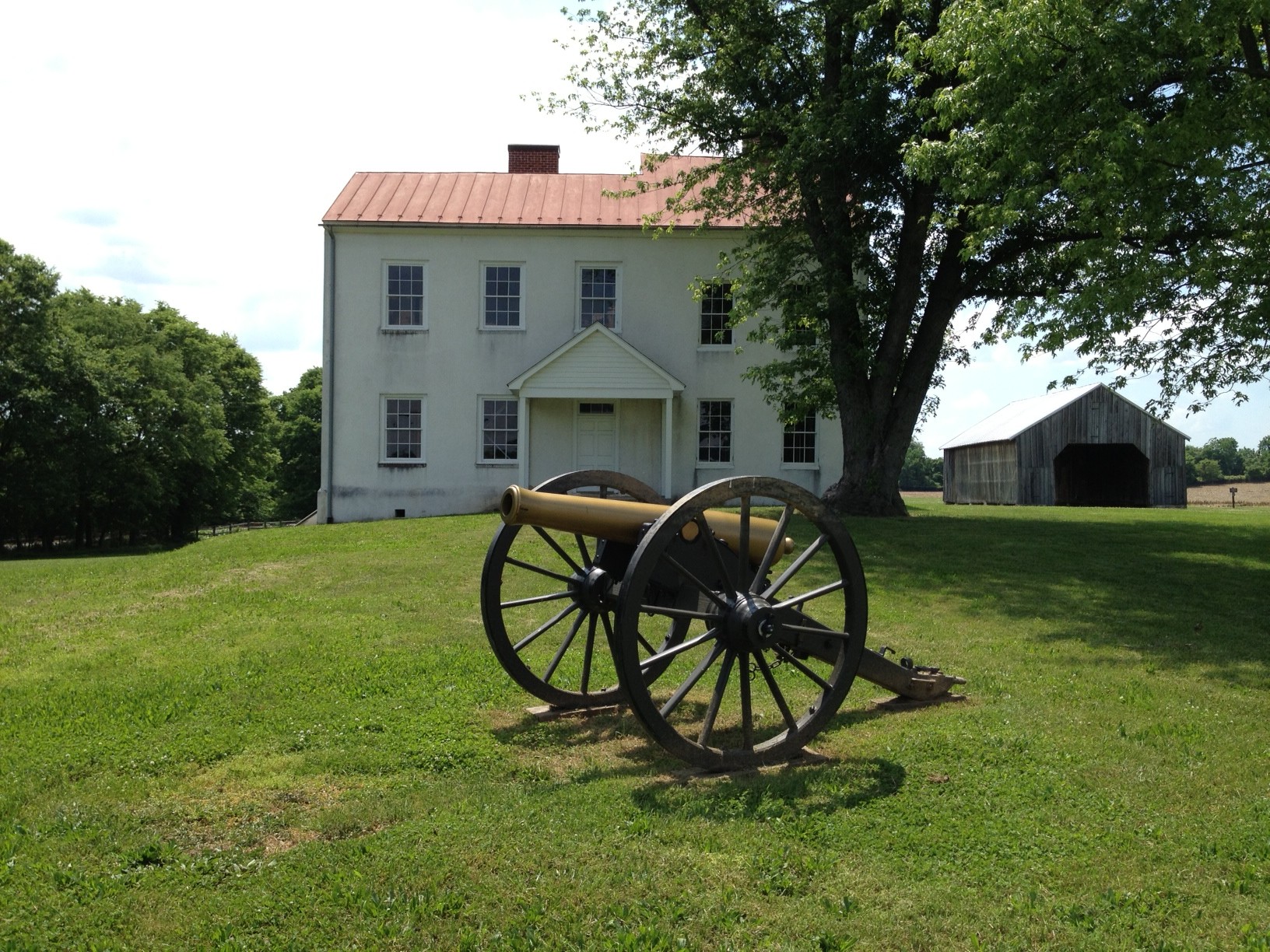

 collection. My dad and I split the Baltimore-related books (more on that in a minute). Near the top of one of the shelves, I found a collection of electrical engineering textbooks that I can only assume he used during his training in the Navy. They don’t seem like they’d be very old – they’re only from the 1930s – but one of the books admits right up front that we don’t really understand a lot about electricity, but that it is probably the result of a “tension or strain” in the “ether“. My how far we’ve come, huh? I had to take those.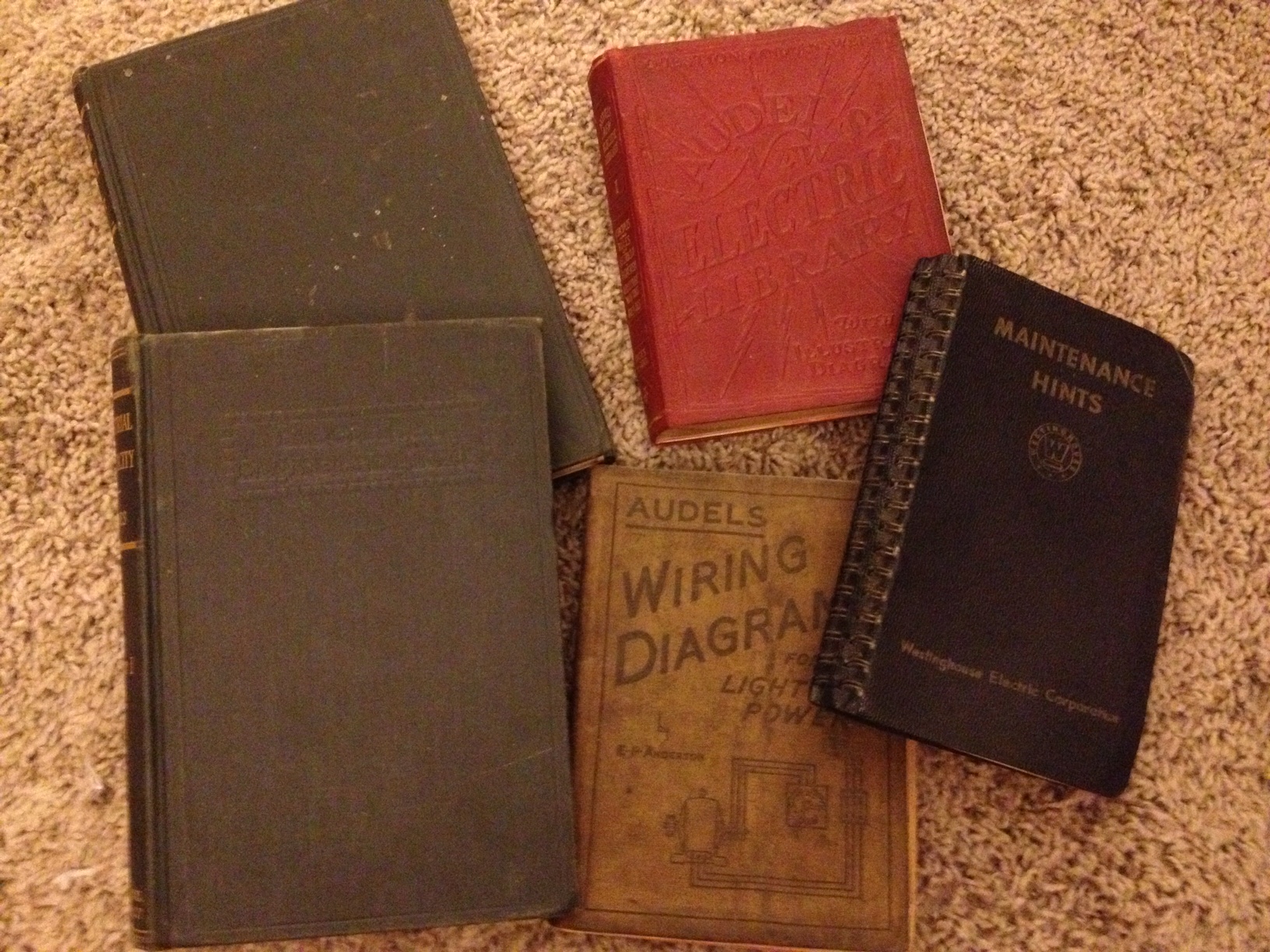
 collection. I had the Gettysburg one as a kid, and I really beat it up, but boy did I love that book. I haven’t dug too deep yet, but the rest of the collection looks just as good.